European Heart Journal Publishes Individual-Patient-Data Analysis of TARGET-FIRST and ULTIMATE-DAPT: Aspirin Discontinuation One Month After PCI in Acute Myocardial Infarction
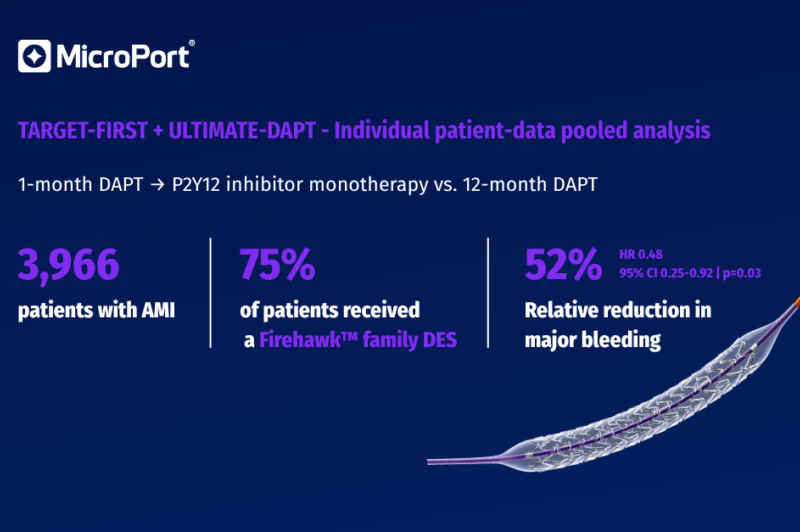
- Largest randomized individual patient-data analysis to date evaluating 1- versus 12-month dual antiplatelet therapy exclusively in patients with acute myocardial infarction (3,966 patients)
- Major bleeding (BARC type 3 or 5) significantly reduced (HR 0.48; 95% CI 0.25–0.92; p=0.03); MACCE met non-inferiority (2.6% vs. 2.8%)
- Firehawk™ was the drug-eluting stent used in 75% of patients in the pooled cohort
Clamart, France – September 04, 2026 – MicroPort® today announced the publication in the European Heart Journal of an individual patient-data pooled analysis of the TARGET-FIRST and ULTIMATE-DAPT randomized clinical trials, evaluating abbreviated dual antiplatelet therapy (DAPT) following percutaneous coronary intervention (PCI) in patients with acute myocardial infarction (AMI).1 The results were presented as Late-Breaking Science at the European Society of Cardiology (ESC) Congress 2026 in Munich, Germany.
The pooled analysis included 3,966 patients with AMI who remained event-free on DAPT at 1 month after PCI, and compared aspirin discontinuation at 1 month followed by P2Y12 inhibitor monotherapy with conventional 12-month DAPT. The analysis represents the largest exclusively AMI cohort to address a 1-month versus 12-month DAPT strategy.
Early aspirin discontinuation met the primary superiority endpoint. Major bleeding (BARC type 3 or 5) was significantly reduced with early aspirin discontinuation vs. conventional 12-month DAPT (0.7% vs 1.4%; HR 0.48; CI 0.25-0.92; p=0.03). MACCE, the primary non-inferiority endpoint, occurred in 2.6% versus 2.8% (difference −0.2%; 95% CI −1.2% to 0.8%) meeting prespecified non-inferiority criteria.
Clinically relevant bleeding (2.3% vs. 5.3%; HR 0.43) and net adverse clinical events (4.7% vs. 7.5%; HR 0.62) also favored monotherapy.
The analysis synthesizes evidence from two major randomized controlled trials:
- TARGET-FIRST2 (NCT04753749) evaluated 1-month DAPT followed by P2Y12 inhibitor monotherapy versus 12-month DAPT in selected patients with AMI who achieved complete revascularization with Firehawk Liberty™.
- ULTIMATE-DAPT3 (NCT03971500) evaluated 1-month DAPT followed by ticagrelor monotherapy versus 12-month DAPT in patients with acute coronary syndrome undergoing PCI with contemporary drug-eluting stents. The present pooled analysis included the AMI population from the trial.
“Pooling patient-level data from TARGET-FIRST and ULTIMATE-DAPT lets us assess much more precisely how bleeding and ischemic risk balance out when aspirin is withdrawn one month after PCI in patients with acute myocardial infarction. For clinicians, it strengthens the evidence for a shorter course of dual antiplatelet therapy in selected patients after a heart attack, and helps identify those most likely to benefit from an earlier switch to a single antiplatelet agent,” said Professor Giuseppe Tarantini, Head of Cardiology at the University Hospital of Padova, Italy, principal investigator of TARGET-FIRST and first author of this pooled analysis.
“Evidence supporting early aspirin withdrawal has largely been generated in broader or mixed populations,” said Professor Shao-Liang Chen, Nanjing First Hospital, Nanjing Medical University, an author of this analysis and principal investigator of ULTIMATE-DAPT. “By focusing specifically on a large population of patients with myocardial infarction across both European and Asian practice, this analysis provides additional evidence to support individualized antiplatelet treatment decisions.”
“This publication underscores the vital role of sustained and collaborative clinical research into antiplatelet optimization following PCI,” said Brian Y. Chang, MD, PhD, Chief Medical Officer of MicroPort®. “With Firehawk™ used in 75% of patients included in the pooled cohort, we are pleased that the platform has contributed substantially to the growing global body of clinical evidence. We remain committed to supporting research that empowers physicians to make informed, personalized treatment decisions for their patients.”
About Firehawk™ and Firehawk Liberty™
All Firehawk™ stents have the same core technology underlying MicroPort®’s latest drug-eluting stents designed for the treatment of coronary artery disease. Its novel abluminal, in-groove architecture confines sirolimus and a biodegradable polymer within laser-cut microgrooves occupying <5% of the strut surface, leaving ~95% as bare metal. This design combines the anti-restenosis benefits of modern third-generation drug-eluting stents with the healing benefits of a bare-metal stent by only delivering drug where it is needed and minimizing overall polymer and drug footprint. Firehawk Liberty™ combines this drug-eluting stent technology with the latest generation delivery system that improves crossability, trackability, pushability, and expansion to improve operability on complex lesions. Clinical outcomes depend on patient and lesion characteristics. The pooled analysis evaluated antiplatelet treatment strategies and was not designed to compare outcomes between individual stent platforms.
About MicroPort®
Since 1998, MicroPort® (MicroPort Scientific Corporation; HKEX: 00853) has been breaking barriers and accelerating access to life-changing solutions so that patients everywhere can live better and longer lives. As a global medical device company, MicroPort® provides solutions across eight therapeutic areas, including comprehensive cardiac care; aortic and peripheral vasculature interventions; robotics, life support, and clinical AI; neuroscience; and orthopedics. Serving over 100 countries and 20,000 hospitals, MicroPort® provides a medical solution to a patient every 5 seconds.
Regulatory and Clinical Information
Product availability, indications, and regulatory status may vary by country or region. Firehawk™ and Firehawk Liberty™ should be used in accordance with their locally approved indications and instructions for use.
References
- Tarantini G, et al. One vs twelve month aspirin after percutaneous coronary intervention for acute myocardial infarction: individual patient-data analysis of TARGET-FIRST and ULTIMATE-DAPT trials. European Heart Journal. 2026;ehag737. doi:10.1093/eurheartj/ehag737.
- Tarantini G, et al. Early Discontinuation of Aspirin after PCI in Low-Risk Acute Myocardial Infarction. N Engl J Med. 2025 August 31. DOI: 10.1056/NEJMoa2508808
- Ge Z, et al. Ticagrelor alone versus ticagrelor plus aspirin from month 1 to month 12 after percutaneous coronary intervention in patients with acute coronary syndromes (ULTIMATE-DAPT). Lancet. 2024;403(10435):1866–1878.